Haralambie Cicma Autobiographie part 1
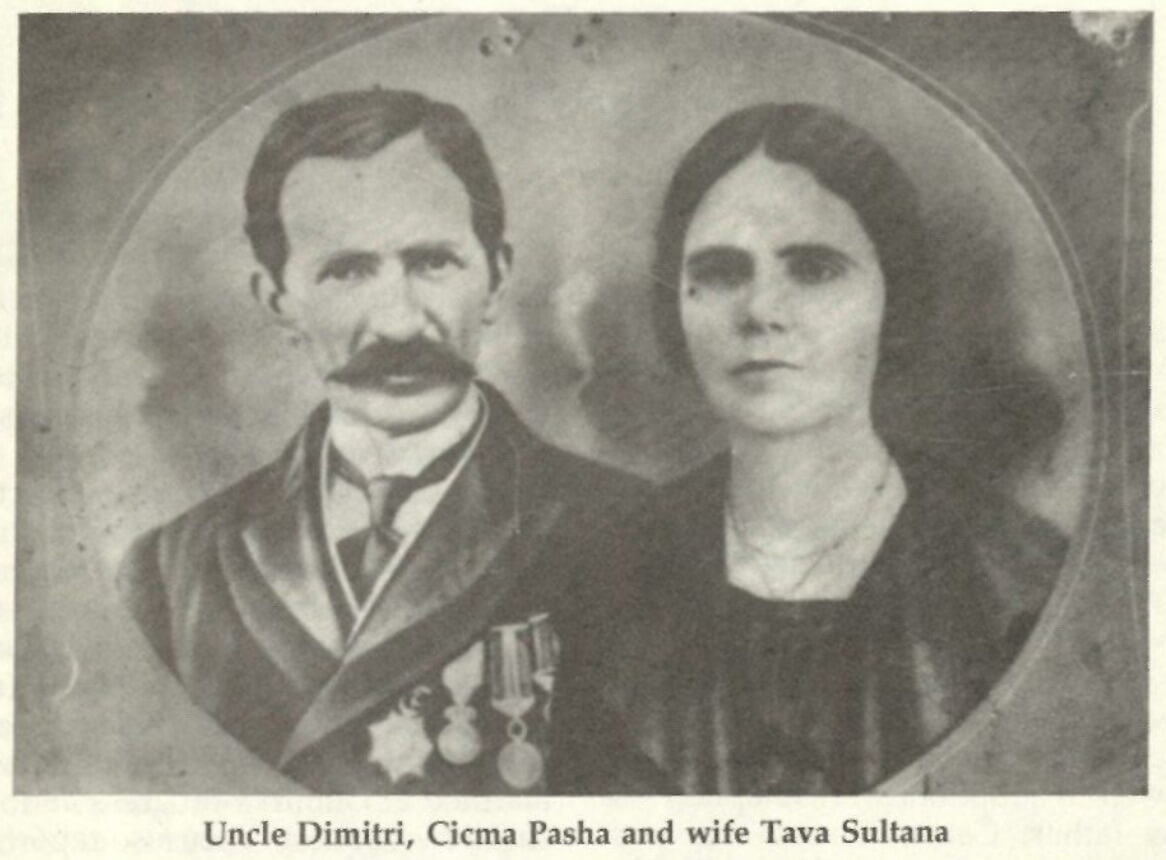
A Vlach’s Life in His time Part I. Family My grandfather, Costa Cicma and his wife, Despina, had eight children; four sons—Dimitri, George, Nicholas and John, also four daughters— Maria, Kiratsa, Theodora and Hrisa. He was not wealthy, his pay as a leader of the Armatoli (protectors of the town) was not sufficient to support ...
Aromanian News: Issue 1
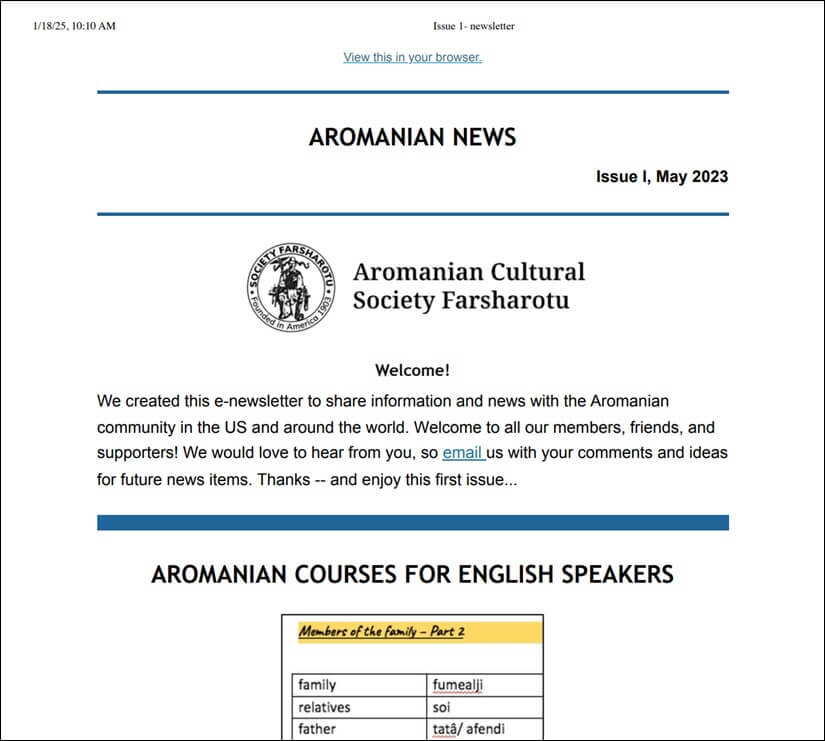
Welcome! We created this e-newsletter to share information and news with the Aromanian community in the US and around the world. Welcome to all our members, friends, and supporters! We would love to hear from you, so email us with your comments and ideas for future news items. Thanks — and enjoy this first issue… ...
The Vlachs in Macedonia in the 19th and 20th Centuries
THE VLACHS IN MACEDONIA IN THE 19TH AND 20TH CENTURIES* By Nikola MiNov ABSTRACT: This article summarizes the known data about the localization and numerical distribution of various Vlach groups in Macedonia in the 19th and 20th centuries. Each Vlach group’s (Moscopolitan; Grammoustian; Farsherot and Moglenite Vlachs) migrations are analyzed separately, following them from their ...
The Ethnic Composition of Medieval Epirus
The Ethnic Composition of Medieval Epirus by Brendan Osswald ABSTRACT Medieval Epirus was the melting pot of many migratory influxes, whether Slav, Vlach, Jewish, Albanian or Italian. Some Greek refugees also found asylum in this province during hard times. The best documented period is that from 1200 onwards. During the last three centuries of the ...
Aromanian Zoonymica from Kleisoura (prefecture of Kastoria)
Aromanian Zoonymica from Kleisoura (prefecture of Kastoria) by Nikolaos Siokis The animal denominations of Kleisoura remained uninvestigated up till the present times and we should seek the causes of that in the difficult rendering from the Aromanian language that is spoken in the townlet even today. We should also seek causes in the weakness of ...
The Vanishing Aromanian by Eugene Matzota
Page Numbers: 330 Publication Date: 2018 Publication Name: The Vanishing Aromanian Aromanian […]is spoken by half a million people, mainly in parts of northern Greece, Albania, the Former Yugoslav Republic of Macedonia, and Bulgaria.” , said Martin Maiden . The Aromanian Question, as Max Dreysuss said in his book , is not new, but has ...
The Memoirs of Cola Nicea: A Case-Study on the Discursive Identity Construction of the Aromanian Armatoles in Early 20th Century Macedonia
The Memoirs of Cola Nicea by Vladimir Creţulescu ABSTRACT: The article begins with a general presentation of Cola Nicea’s Memoirs – the document which is to be investigated using methods drawn from Critical Discource Analysis. The paper continues with a study of the ethnonyms used by Nicea throughout his account, which leads into a discussion ...
The Role of the Vlachs in the Bogomils’ Expansion in the Balkans
The Role of the Vlachs in the Bogomils’ Expansion in the Balkans by Octavian Ciobanu The paper approaches an old idea about the contribution of Vlachs to the spread of Bogomilism in the Balkans. Vlachs and Slavs had the greatest contribution to the expansion of Bogomilism. To explain the role of the Vlachs, the article ...
Aromanian Language and differentiated geographic varieties
Aromanian Language and differentiated geographic varieties: A teaching approach, problems and propositions by Evegenia Ntasiou ABSTRACT: This contribution discusses a project to strengthen Aromanian. Aromanian or Vlach is an Eastern Romance language spoken in South-eastern Europe. Its speakers are called Aromanians or Vlachs. Aromanian has three main dialects; Pindean, Fãrshãrot and Gramustean. It is spoken ...
Vlachs and their own History
by Basil Gounaris To view the full article, sign up for a free account at Academia.edu If you already have an account, use the following link to sign in and download the article: https://www.academia.edu/29765681/Vlachs_and_their_own_History
Multipart Singing among the Aromanians (Vlachs)
By Thede Kahl Abstract: Similar styles of multipart singing are common among the Albanians, Greeks and Aromanians in the south of Albania and the northwest of Greece. The Aromanians – called Vlachs by their neighbors – live as minorities throughout the southern Balkans, especially in northern Greece, southern Albania and the Republic of Macedonia. ...
Constantinople and the Echo Chamber: The Vlachs in the French Crusade Chronicles
Florin Curta Department of History, University of Florida Abstract: The chroniclers of the Fourth Crusade (Geoffroi de Villehardouin, Henri de Valenciennes, and Robert de Clari) have much to say about the Vlachs. Much of that information results from direct contact with the Vlachs, particularly in the case of Villehardouin and Henri de Valenciennes. However, several ...
Being an Ottoman Vlach: On Vlach Identity(ies), Role and Status in Western Parts
Vjeran Kursar abstract: Following the Ottoman conquest of the Balkans, the Vlachs, still a largely nomadic and semi-nomadic population, made special arrangements with the conquerors. They served as a colonising force in newly conquered areas, manning auxiliary military units such as voynuks and martoloses, etc. In exchange, the Ottomans granted the Vlachs wide exemptions ...
Linguistic Balkanization: Contact-Induced Change by Mutual Reinforcement
JOUKO LINDSTEDT (UNIVERSITY OF HELSINKI) Introduction: The Balkan Sprachbund was the first linguistic area discovered by modern scholarship. According to Kopitarís (1829: 86) famous statement about Albanian, Wallachian, and Bulgarian (in modern terms: Albanian, Balkan Romance, and Balkan Slavic), in the Balkans ìnur eine Sprachform herrscht, aber mit dreyerley Sprachmaterieî. The main features of the ...
THE ROMANIAN STUDENT TRIP TO ATHENS (ON AUGUST 27 – SEPTEMBER 10, 1901)
ȘTEFAN PETRESCU (Institute for South-East European Studies, Bucharest) Abstract Grigore Tocilescu, professor of Ancient History of University of Bucharest, organized a student trip to Greece in 1901. This travel took place in the context of re-established Greek- Romanian diplomatic relations. Around 300 people – students, professors, doctors, journalists, lawyers – visited the most important archaeological ...
THE EMERGENCE OF VLACH NECROPOLISES WITH PETROGLYPHS IN WESTERN BALKANS
Octavian CIOBANU Abstract The paper deals with some activities and traditions of Vlachs connected to the emergence of necropolises with impressive tombstones and petroglyphs in Bosnia and Herzegovina, and in surrounding countries like Croatia, Serbia and Montenegro. The paper approaches the traces of the Vlach transhumance in the Western Balkans and the connection between transhumance ...
Macedonian Questions
BASIL C. GOUNARIS Abstract Despite many recent postmodernist approaches ‘historicity’ as a quality of state rights in the Balkans was not dismissed. Ethnicity, in its historic dimension, is still considered almost unanimously as the fundamental ingredient of any attempt to understand the Macedonian Question; be it for strengthening or for weakening state or minority arguments. ...
SOCIAL CLEAVAGES AND NATIONAL “AWAKENING” IN OTTOMAN MACEDONIA
Basil G. Gounaris Thessaloniki Introduction In early summer 1992 a lavish monograph was published in Skopje entitled Macedonia on old Maps. In the first chapter of the book, which is called ‘A History without a Geography,’ Ilija Petrushevski states that: These maps present the undeniable historical and scientific facts about the distinctness of the ...
The Vlachs of Greece and their Misunderstood History
Helen Abadzi January 2004 Abstract The Vlachs speak a language that evolved from Latin. Latin was transmitted by Romans to many peoples and was used as an international language for centuries. Most Vlach populations live in and around the borders of modern Greece. The word „Vlachs‟ appears in the Byzantine documents at about the 10th ...
From the Editor: Looking Back at Thirty Years of Publication
It’s hard to believe we’ve been publishing The Newsletter of The Society Farsarotul on and off for 30 years. We wrote then: “We hope that this first issue of our Newsletter finds you and your loved ones well and prosperous. We want to let you know that the Society Farsarotul, too, is well and prosperous ...