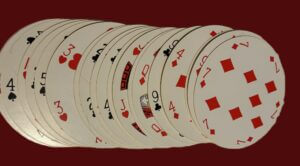
In the Balkans, this game, also referred to as Tabinet (or Tablić or Tablanet), is a fishing game using the now standard 52 card deck (no Jokers). This game is frequently played to help children learn to count and add, and as a foundation for other basic card games. We have had requests from several Society Farsharotu members to post the rules for this game, which many of us remember from our childhood. Here are the rules, thanks to Mary Jennifer Costulas and her nephew, who figured out the relationship of dondonets to tabinet.
**Dondonets: Rules of Play**
2, 3, or 4 players
1. The Deck and Setup
The Deck is a standard 52-card deck.
Choose a dealer; the deal rotates counter-clockwise after each hand.
* **The Deal:** Each player is dealt 4 cards (in some versions this deal is 6 cards). Four cards are placed face-up on the table to start the round. If there are 3
players, the final deal may be adjusted.
* **The Goal:** Capture as many “point cards” as possible from the table.
**Winning:** The player with the most total points wins the round. Games are often played to a set total, such as 51 or 101 points. For many of us as kids, 101 was the standard.
2. Card Values (for Capturing)
When capturing cards from the table, use these numerical values (different than for final scoring):
Ace: 1 or 11
2 through 10: Face value
Jack (J): 12
Queen (Q): 13
King (K):14
The suits are not significant in this game, except that the

10 and

2 are worth extra points in the scoring.
3. How to Play
The player to dealer’s right plays first, and continues counterclockwise.
On your turn, you play one card from your hand to the table. You can capture cards in two ways:
* **Matching: A 10 from your hand captures a 10 on the table.
* **Summation: A 10 from your hand captures a 6 and a 4 (or a 7, 2, and Ace).
* *Note: In some versions, you can capture multiple groups at once. For example, playing a 10 can capture a 10, a 7 and a 3, and a 6 and a 4 all in one turn. You will need to decide ahead of time how to rule this.
* **Face Cards (J, Q, K): These usually only capture their exact numerical match (e.g., a King can only take another King).
Place your matches horizontal in front of you.
If the card you play cannot capture anything, it remains face-up on the table for the next player
4. The “Tabla” (The Sweep): If you play a card that captures every single card currently on the table, you have made a “Tabla,” this earns you 1 bonus point
To track this, place one captured card face-up and sideways in your winning pile.
The only major difference between Tabinet and Dondonets is this item, the “Tabla” (The Sweep), which describes when you pick up all the cards and “clear the table.” In the Aromanian version, we say “una la mine” (originally we called this “one for table” but over time it became “one for me.”).
The Next Turn: After a sweep, the table is empty. The next player must place a card from their hand onto the table. If the following player can match that card exactly, they also score a Tabla.
5. Round End: When everyone has played their 4 cards, another 4 are dealt to each player from the remaining deck. This continues until the deck is empty, this ends the hand.
Final Turn: Any cards remaining on the table after the very last card is played are taken by the last person who made a capture.
6. Scoring: You earn points three ways and is easiest if each player keeps track of their own points during the game and then share them with a player designated to be scorekeeper. During the game track the number of pairs and “una la mine-s”
Each “Tabla” (Sweep) = 1 Point
The player with the most cards gets a 1 Point bonus.
At the end of the game, players sort through their captured piles.
Only specific cards carry points:
Each Ace: 1 Point
Each King (K) : 1 Point
Each Queen (Q): 1 Point
Each Jack (J): 1 Point
Each 10 (except 10 of Diamonds): 1 Point
10 of Diamonds (The “Big 10”): 2 Points
2 of Clubs (The “Small 2”): 1 Point
7. Winning: The player with the most total points wins the round. Games are often played to a set total, such as 51 or 101 points. Decide beforehand how you want to set up the winning points.
There are many variations of this game. If you played with different rules, let us know!
There are also apps you can download to play online with friends or against the app itself.




Responses