Artist Interview: Patricia Chiacu Apuzzo
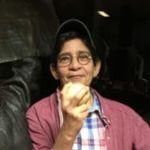
In conversation with elissa mondschein
In November of 2025 I had the chance to speak with Society Farsharotu member Patricia Chiacu Apuzzo about her life and art. Rebecca Townsend helped with formulating the questions and setting up the interview. Thanks to Patricia for her generosity of time, and for assistance in editing the interview.
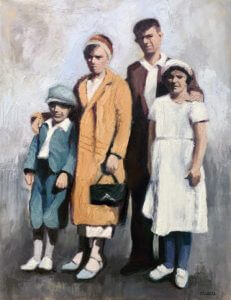
Leaving Albania, 1933 (oil on canvas)
My dad, (from left) Sotir Chiacu, sister-in-law Aspasia Chiacu, brother Costica Chiacu, sister Lucreta Chiacu the day they left Albania for New York.
elissa: Tell me about your family, who are your people?
Patricia: I am part of the Chiacu family, my father Sotir (Sam) being the youngest of 10 children. My mother, Mary Rutcha and her brother, Leo, were born in Blackstone, MA. My maternal grandparents were Aromanians from Almyros, Greece. I was born in New York City but we moved to Connecticut when I was around eight because my father started a business there. We were the first ones to move “to the country” but many trips were made back to New York to visit aunts, uncles and cousins.
I’m the oldest of three children. I have a brother, Vasil and sister, Dale. Most of my life I have lived in Connecticut. I moved to Pittsburgh [PA] 13 years ago. My daughter had moved here and said “why don’t you try Pittsburgh for a year, it’s more affordable.” It was a time and a place where I could devote myself totally to painting. I gave myself a year to try it out. Here it is two granddaughters and thirteen years later! I’ve done quite well here and I have a gallery that represents me. I’ve sold quite a few paintings and I’m still selling. I paint almost every day.
elissa: What was important to your identity as you were growing up?
Patricia: Because my father had a large family there were a lot of cousins and that was super important to me. The time spent with cousins and relatives at our family gatherings, including the pitas and ghela, and all the other good food that was lovingly prepared, are such good memories! Even though my mother was born here, her parents were from Greece and my father being born in Albania, I have always felt like an immigrant’s daughter. I remember telling one of my good friends in second grade that my cousins were coming over. She asked how many cousins I had and I said I had alot. She said she only had one and I remember thinking that was just so strange! Going to my friends’ houses at an early age, I noticed we weren’t that kind of American. I was 12 or so when my grandmother came to live with us. She was widowed. I never knew either of my grandfathers. She mostly spoke to me in Aromanian and broken English but I always answered her in English. I never encountered that situation in the friends’ houses I visited but with all of my cousins it was so very similar. Aromanian was spoken by many in family life. I felt like I had my home life and my American life.
elissa: When you got together as a family, say for name days or other occasions, did you put on music and dance? How about at weddings?
Patricia: I remember the name days well growing up – sometimes when the older men got to feeling good they would sing in the droning style. We would celebrate my father and brother’s namedays. The house was full of company. My mother would spend so much time preparing all the food, because you never knew how many were going to come. In those days my mother would say to me: “take the tray and go serve the older ladies first”. The tray would consist of a spoon of prepared preserves, a shot of whisky, and a glass of water. I was so nervous I was going to spill something on one of them!
At weddings I always loved the dancing and the music. I felt so much pride when my mom or dad would lead the line.
I have very good memories of all that! I do miss the dancing. In fact, when I paint I always listen to music of all kinds. When I’m in the Vlach mood, I sometimes listen to a channel of takis katoVermion on YouTube, and I’ve actually gotten up [to dance] if the music moves me! Both of my children know how to do our dances but I feel after me it’s going to fade away because they don’t have the advantage of having a big family close together.
elissa: And the European connection is also a bit lost, farther away.
Patricia: I’m glad that they like it but their memories are not like mine or yours. I think we’re the last generation to experience that.
elissa: When did you become involved with The Society Farsharotu?
Patricia: I’ve always been interested in The Society. My father was a member, so I became a member when I lived in Connecticut. I found the newsletters very informative. I remember one newsletter in particular with an article written by George Moran, Touring the Vlach Villages of Greece. From that day I wanted to go to Greece and Albania.
I remember always asking my parents – I would say, “Dad, you’re from Albania, and Maia and Papu were from Greece. How do you know the same language?” And he would say, “We’ll, we’re Aroman.” Nobody could really answer those questions for me. So that newsletter and what George wrote really resonated. I think I’ve passed that along to my children. My son studied history but was able to make his own major. He studied about our people in Greece for two semesters. In the summer of 2007 my daughter and I met up with him who, at that time, was in Thessaloniki. We rented a car, and, inspired by George Moran’s article, we set out on our own journey across Greece to do the same. It was a wonderful trip and truly one of the most memorable “finding-your-roots” experiences.
elissa: Were you artistic as a child, or did you have other interests at the time?
Patricia: [On] my second grade report card the teacher wrote, “Patricia shows an ability in art, she loves to draw.” In high school, taking courses to prepare for college, I thought maybe I would be a teacher. I ended up taking an art class because my requirements were filled. I took two more art classes and that was a game changer for me. I went to The University of Connecticut and graduated with a BFA in oil painting. I don’t feel like I learned much there. I got as much out of it as I could but I consider myself self taught. When I got out of school I went back home to live. Luckily there was a small advertising agency in Darien that hired me. I didn’t take any graphic design courses in school so there was much to learn. At the agency we had ads to do and I was able to draw the artwork for some of the ads.
From there I freelanced as a graphic artist, mostly for newspapers and magazines. I worked for many years at a daily newspaper and a number of weekly newspapers. Before I retired I was Art Department Supervisor at a daily newspaper. It was all computer work. Because I was the head of the department there were a lot of long days. Somehow I managed, though mostly on weekends, to paint. It has always been my passion.
elissa: What is the medium you use most?
Patricia: I started out as an oil painter. I know artists are supposed to have a niche, but I really don’t. If anything, I consider myself an abstract painter, but I also enjoy doing figurative pieces. If something inspires me, or I get an idea, I work through [it in] a series. I am currently doing a series called “Organic Abstractions”. Another series, “Small Works” are very small paintings, abstract and figurative, done in various mediums. “People And Places” are paintings inspired by photos. I’ve experimented with many mediums in my work: oils, casein, acrylics, inks, fabrics, and various papers. In mixed media pieces there are textural things such as sand or sawdust that I add to the paint or medium.
elissa: Are there themes you explore? You talked about working in series. When you start a piece, what terms do you think of it in?
Patricia: The smallest thing can inspire me. Sometimes it’s an old photo, like Lena. One thing that’s always driven my work is color. Whether it’s figurative, abstract, that’s the thing that drives me. My work really doesn’t need any explanation. Whatever the viewer sees or feels is what matters.
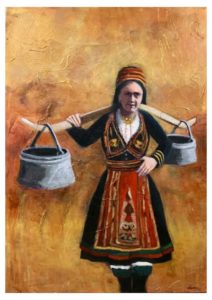
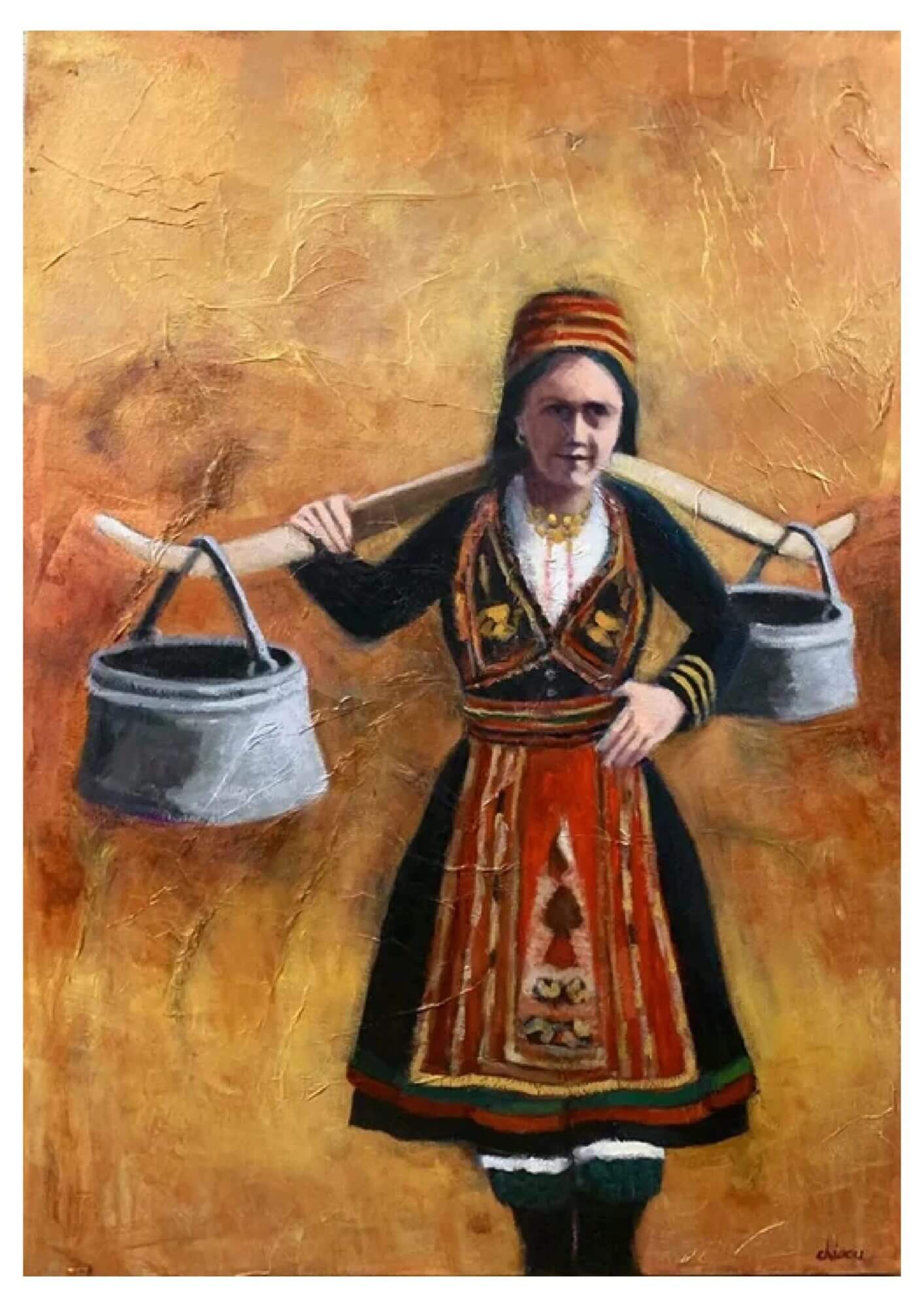
elissa: What was the inspiration for Lena and how did the donation come about?
Patricia: I was listening to Aromanian music in the studio and a song came on, Lena. On that video there is a slide show of old photos and this picture came up of a girl. I had this idea of how to paint her. I had to make the costume up. There’s a lot of gold in that painting, and my idea was to bring in the influence of the use of gold in icons. I wanted to bring that element in. Her name is Lena, but my great grandmother’s name was Elena, and my granddaughter’s name is Elena, so it was the music as well as the song title that inspired me. After it was completed I decided I would like to gift it to the Society in honor of my mother and father.
elissa: There’s a section on your site called “People and Places” and there’s one painting titled, There’s a Party Goin’ on Right Here Rebecca and I were actually wondering if that was family.
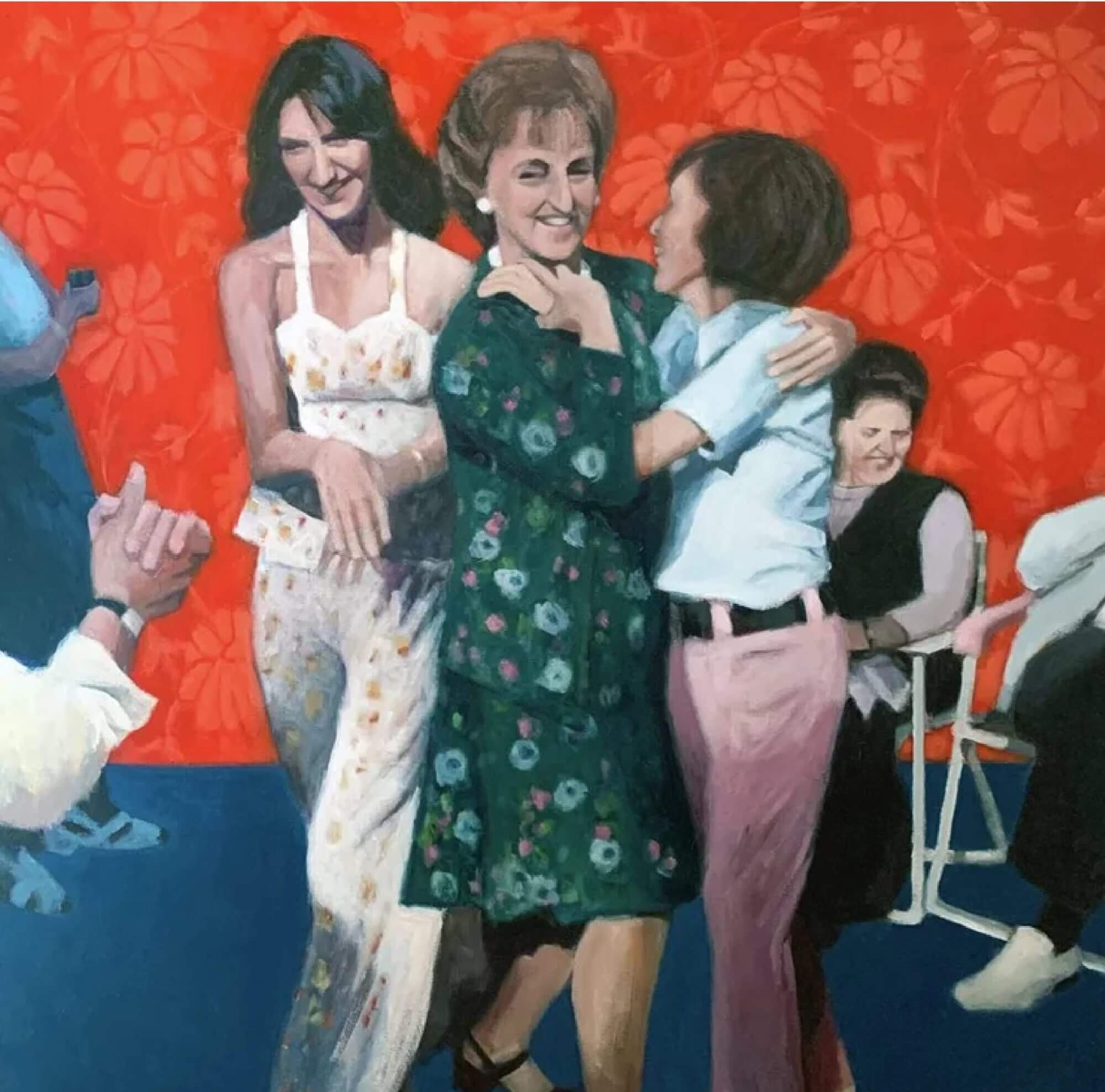
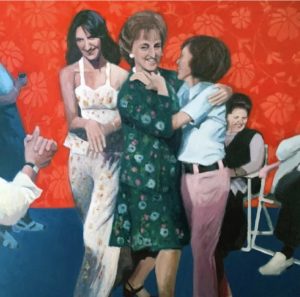
Patricia: Yes! That’s actually my mom, me – I’m on the left – and my younger brother. It was on my parents 25th wedding anniversary. My siblings and I gave them a surprise party at our house in Norwalk. The yard was filled with people and we were [all] together, and somebody took a snapshot. I came upon that photo in my photo box and I thought “I have to paint this.” I remember the day and how happy we all were. I just wanted to paint it as a remembrance of that day. In that photo there’s a hand, on the left side, that’s my father’s arm, he was dancing with my sister. In the background there’s a woman slightly cut off, that was my grandmother. So we’re all in there. I entered that in a juried show in Pittsburgh through The National Association of Women Artists. The painting is quite large and I normally don’t submit large pieces because of mailing cost but since the show was here in Pittsburgh I decided to submit it. Not only did it get in the show, but the owner bought it for the permanent collection of the Tomayko Foundation. I was quite surprised because it was such a personal family piece.
elissa: When you said it was really large, what is really large?
Patricia: I think it was 36”x40”. I love to paint large.
I have always marveled at the artwork on the icons that we have. I have also painted icons, not the way Margaret [Felis] does, not in the traditional way. I used oil paint and did this to teach myself the discipline. [They] are on wood, and varnished, but it is oil paint not tempera. It is like copying the old masters. It’s a learning process. I also feel they are so much a part of myself.
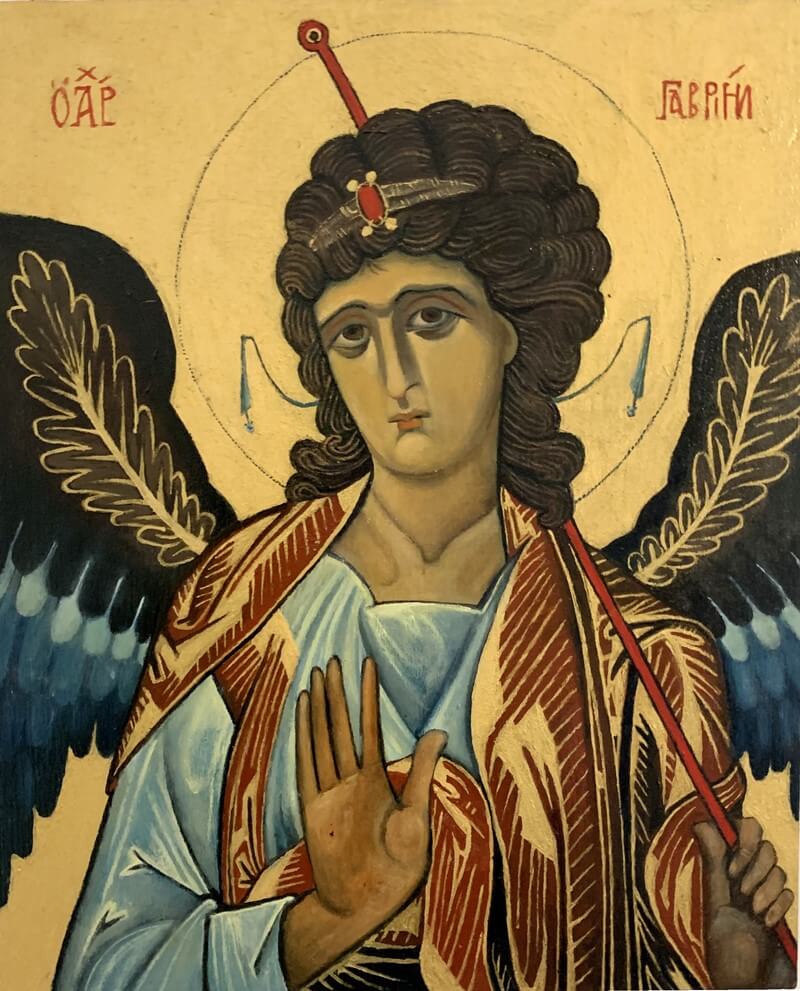
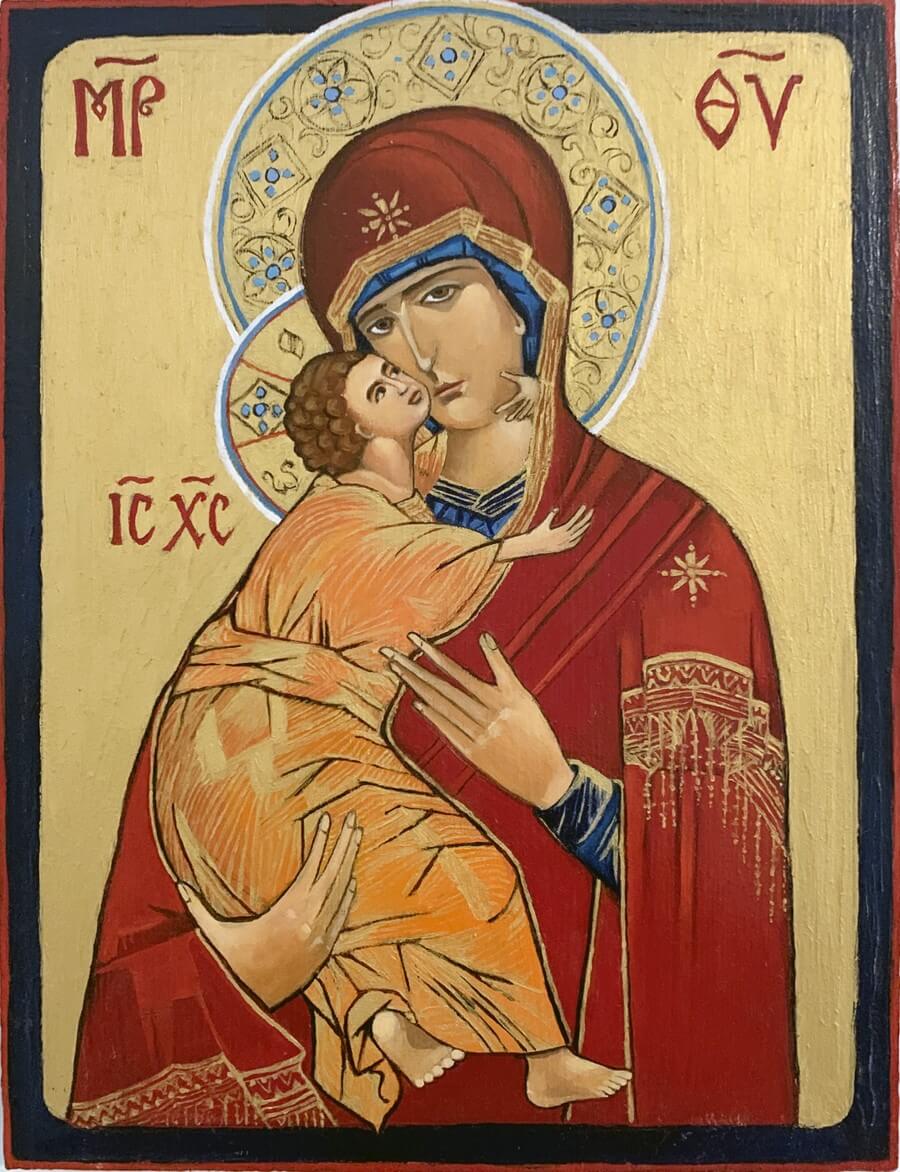
Patricia: Aside from the icons, there is one picture that I have that I did of when my father came over on the boat from Albania. It’s him, his sister Lu, his sister-in-lawAspasia and his older brother Kostica. What happened was that I made a big painting of that photo and I brought it to the gallery. And I thought “who’s going to want this picture?” And it sold! A German woman who was an immigrant herself bought that painting. I repainted it smaller, in oil. My roots, the day my father left Albania to come to America, is very dear to me. This one is not for sale.
elissa: One last question, when did you put your website together? Do you manage the website yourself? How about the photography of the paintings?
Patricia: I do it all myself. I use Squarespace, which is very manageable. Since I know my way around computers it’s easy for me to do. I use my phone [for the photos] and try to get the best true likeness I can.
elissa: It has been wonderful to talk with you, thanks so much for your time and generosity in this interview!
Patricia: I am honored that you thought to interview me. Many thanks to you, Rebecca, and The Society Farsharotu.
I loved reading this article about my sister and our history.