From the Hills of the Balkans to the Streets of San Francisco: An Unexpected Modern Aromanian Story

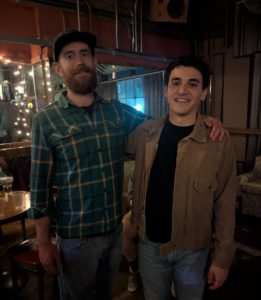
Ryan Batjiaka and John Bica
(photo at: Ashkenaz Music & Dance Community Center, Berkeley CA)
This past year, two members of the Farsharotu Society—John and Ryan—crossed paths in an unexpected yet enriching way. With no prior knowledge of one another, they first met virtually as students in the 2024–2025 Aromanian Online Language Course. As the weeks passed, the small class size and increasingly personal discussions naturally brought them into conversation.
By May 2025, as the course wrapped up, John learned that Ryan had recently relocated to San Francisco—the same city he called home. It felt only natural to meet in person, so they arranged a dinner to celebrate the end of the course and continue their conversation beyond the screen.
John and Ryan come from distinctly different backgrounds and life trajectories: John is a second-generation Aromanian who grew up in New England, with paternal Farsharot roots tracing back to Romania, while Ryan was raised in California and carries Aromanian heritage on his father’s side, whose family immigrated from Greece. Despite these differences, they found a shared thread—bonding over stories, family histories, and a mutual passion for Aromanian language, history, and culture.
Following their dinner, the two attended a lively Balkan folk music and dance event at the Ashkenaz Music & Dance Community Center in Berkeley. The beloved West Coast band Dromeno, known for its Greek and Balkan repertoire, was back in town and performed traditional songs from Macedonia. Ryan joined in for his first-ever Balkan folk dances, including the paidushka and tsamiko—both dances often embraced by Aromanian communities. Impressively, John knew many of the dances from continued passion and exposure to folk dancing.
The communal energy of the evening, filled with music, dance, and connection, was a fitting way to cap off a newfound friendship rooted in cultural curiosity and shared heritage. In many ways, their story echoes a timeless truth seen across generations of Aromanian history: even the smallest thread of common and increasingly rare heritage can bring strangers together in meaningful and lasting ways.
Such a great story! I can picture you dancing and enjoying a new found friendship with cultural ties that will last a lifetime! Congrats Ryan and John.